Introduction
Choosing the right NTC thermistor is essential for accurate temperature measurement, reliable temperature control, and long-term product performance. NTC thermistors are widely used in home appliances, water dispensers, automotive electronics, battery management systems (BMS), medical equipment, industrial controls, and many other applications.
However, selecting an NTC thermistor involves more than choosing a resistance value. Two thermistors with the same nominal resistance at 25°C may behave differently at other temperatures because of differences in their B values, resistance-temperature characteristics, tolerances, packaging, and manufacturing processes.
An unsuitable thermistor may produce inaccurate readings, respond too slowly to temperature changes, experience excessive measurement variation, or fail under the application’s environmental conditions.
For engineers, product developers, and purchasing professionals, the best approach is to evaluate the complete set of electrical, thermal, mechanical, and environmental requirements before selecting a component.
This guide explains how to choose an NTC thermistor step by step and what information to provide when requesting a quotation from an NTC thermistor manufacturer.
1. Understand the Application Requirements
Before comparing specifications, define what the thermistor needs to measure and how it will operate.
Start by answering these questions:
- What equipment will use the thermistor?
- What temperature range must it measure?
- Will it measure air, water, a metal surface, a battery cell, or another medium?
- How accurate must the temperature measurement be?
- How quickly must the thermistor respond to temperature changes?
- What mechanical dimensions and electrical connections are required?
- Will the component experience moisture, vibration, chemicals, or repeated thermal cycling?
For example, a thermistor used in a water dispenser may require a waterproof probe with a stainless-steel housing and insulated lead wires. A thermistor used inside a battery pack may require compact dimensions, stable resistance characteristics, and reliable insulation.
These applications may both use NTC technology, but their packaging and performance requirements can be substantially different.
Selection tip: Identify the operating conditions and required measurement performance before choosing a specific thermistor model.
2. Select the Nominal Resistance at 25°C (R25)
R25 is the nominal resistance of an NTC thermistor at 25°C, commonly expressed in ohms (Ω) or kilohms (kΩ).
Typical nominal resistance values include:
- 1 kΩ
- 2.2 kΩ
- 5 kΩ
- 10 kΩ
- 47 kΩ
- 100 kΩ
These values are examples rather than a universal list of standard choices. The appropriate R25 depends primarily on the electronic circuit and the required resistance-temperature relationship.
In many temperature-measurement circuits, the thermistor is connected to a fixed resistor to form a voltage divider. The resulting voltage is measured by a microcontroller or analog-to-digital converter.
Changing the thermistor’s nominal resistance can affect the voltage range, measurement resolution, circuit current, and self-heating behavior.
For this reason, if you are replacing an existing thermistor, you should not select a new component based on R25 alone. You also need to consider its B value and resistance at other operating temperatures.
Example: If an existing design uses a 10 kΩ NTC thermistor at 25°C, a 10 kΩ replacement with a different B value may produce different readings at 0°C, 50°C, or 100°C.
When possible, confirm the original component’s full resistance-temperature specification or obtain its RT table before selecting an alternative.
3. Choose the Appropriate B Value
The B value, also called the beta value, describes the relationship between resistance and absolute temperature over a specified temperature interval.
It is generally expressed in kelvins (K). Common specifications include B25/50, B25/85, and B25/100. The exact temperature interval must be checked when comparing specifications.
The B value is important because it influences how quickly the resistance changes with temperature.
For an idealized NTC thermistor over a specified interval, the resistance-temperature relationship can be approximated by:
R(T) = R25 × exp[B × (1/T − 1/T25)]
Where:
- R(T) is the resistance at temperature T.
- R25 is the nominal resistance at 25°C.
- B is the beta value for the specified temperature interval.
- T is the absolute temperature in kelvins.
- T25 is 298.15 K.
This equation is a useful approximation, but real thermistors may deviate from the simple beta model, particularly across wider temperature ranges.
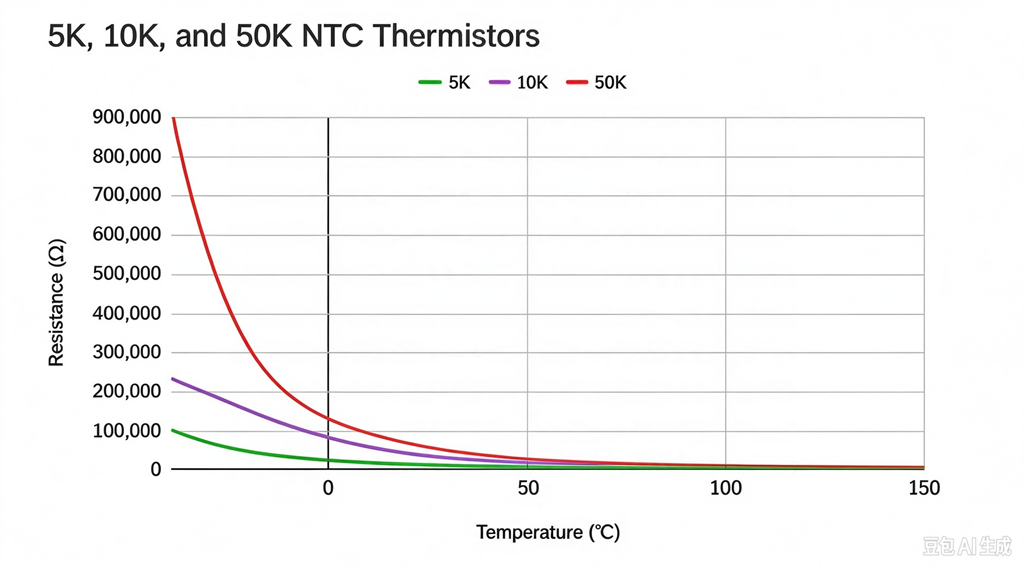
Two NTC thermistors with identical R25 values but different B values will have different resistances at the same temperature away from 25°C.
When selecting a thermistor, check both the B value and its tolerance. Also verify the actual resistance-temperature table if your application requires tight accuracy across a broad temperature range.
4. Define the Operating Temperature Range
The operating temperature range is one of the most important selection criteria.
Consider both the normal working range and the possible extremes during startup, shutdown, transportation, storage, or abnormal operation.
For example:
- A room-temperature sensor may operate within a relatively narrow temperature range.
- A water-heating appliance may require accurate measurements around ambient temperature and at elevated water temperatures.
- An automotive application may experience low ambient temperatures and substantial heat near the engine or other components.
- A battery monitoring system may need reliable measurements across its specified charging and discharging conditions.
The selected thermistor must remain within its rated operating limits throughout the intended application.
However, the rated operating range alone does not guarantee adequate measurement accuracy. A thermistor may remain electrically functional at a particular temperature while its resistance tolerance, long-term stability, or thermal response is unsuitable for the application.
Ask the manufacturer for resistance-temperature data covering the complete required range, especially when measurements at low or high temperatures are critical.
5. Determine the Required Accuracy and Tolerance
NTC thermistor accuracy depends on several factors, including resistance tolerance, B-value tolerance, resistance-temperature curve characteristics, circuit design, calibration, and installation conditions.
Two commonly specified electrical tolerances are:
R25 tolerance: The permitted deviation from the nominal resistance at 25°C.
B-value tolerance: The permitted deviation from the specified B value over the stated temperature interval.
Typical commercial specifications may include R25 tolerances of ±1%, ±2%, or ±5%, depending on the product and application. B-value tolerances also vary by product design and manufacturing capability.
A tighter R25 tolerance does not automatically guarantee better temperature accuracy throughout the entire operating range. B-value tolerance and the accuracy of the actual resistance-temperature curve must also be considered.
For demanding applications, discuss the following with your supplier:
- Required temperature measurement accuracy.
- R25 and B-value tolerances.
- Resistance limits at critical temperatures.
- Whether individual calibration or screening is necessary.
- Long-term stability and repeatability requirements.
If the final sensor assembly includes a metal probe, thermal compound, adhesive, or additional protective materials, its measurement performance should also be evaluated as a complete assembly.
6. Evaluate Thermal Response Time
Response time describes how quickly a thermistor responds to a change in temperature.
It is influenced by the thermistor’s dimensions, thermal mass, encapsulation, surrounding medium, airflow or fluid movement, and installation method.
A small bead thermistor exposed directly to air may respond differently from a thermistor installed inside a thick stainless-steel probe.
For example, a water dispenser may require a probe that responds quickly enough to support temperature control. A sensor installed in a battery pack may prioritize stable and representative cell-temperature measurements over the fastest possible response.
When comparing response-time specifications, check the test conditions. Response time is often defined using a stated percentage of the total temperature change, such as the time required to reach 63.2% of the final change.
Results obtained in moving water cannot automatically be compared with results obtained in still air. The mounting method and test medium must be considered.
If response time is critical, specify the required conditions to your manufacturer and request test data relevant to your application.
7. Choose the Right Thermistor Structure and Packaging
Electrical specifications are only part of the selection process. The physical structure must also suit the installation environment.
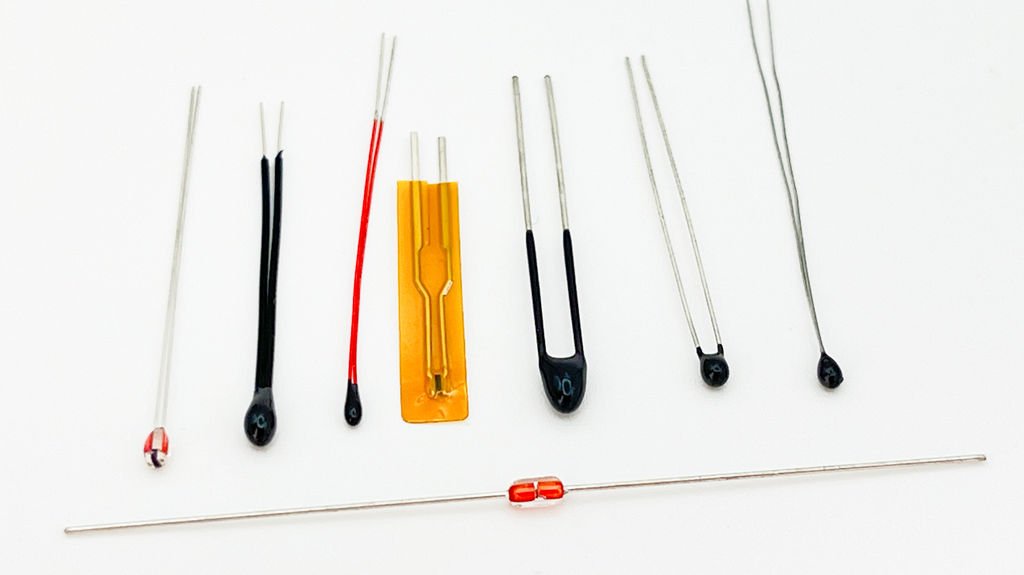
Common NTC thermistor structures include:
Epoxy-coated NTC thermistors: Often used in general-purpose temperature sensing where compact dimensions and convenient lead connections are important.
Glass-encapsulated NTC thermistors: Often selected for applications requiring suitable high-temperature performance, moisture resistance, or environmental stability, depending on the design.
Radial-leaded and axial-leaded thermistors: Useful for different PCB layouts, assembly methods, and lead-routing requirements.
NTC temperature probes: Typically integrate an NTC sensing element with a protective housing, lead wires, and optional connectors. Stainless-steel probes are common in liquid-temperature measurement and industrial equipment.
Custom NTC sensor assemblies: May include specified cable materials, connectors, sealing structures, insulation, protective sleeves, or mounting features.
The correct construction depends on operating temperature, moisture exposure, electrical insulation, mechanical strength, installation space, and cost requirements.
For a water-related application, for example, a bare sensing element may not provide the necessary mechanical protection or sealing. A properly designed probe assembly may be more appropriate.
Do not assume that two products with the same resistance and B value are interchangeable if their physical structures differ.
8. Consider Self-Heating and Measurement Circuit Design
When electrical current passes through an NTC thermistor, it generates heat. This is known as self-heating.
If self-heating raises the sensing element’s temperature above that of the surrounding medium, the measured resistance may no longer represent the actual environmental temperature accurately.
Self-heating depends on factors such as the measuring current, thermistor resistance, thermal dissipation, and surrounding medium.
For accurate temperature measurement, the circuit should generally use a suitable measurement current and avoid unnecessary power dissipation.
Engineers should evaluate the thermistor together with the intended voltage divider, excitation method, sampling frequency, and installation conditions.
The manufacturer’s dissipation constant and thermal time constant can help with component evaluation, but actual performance should be verified in the final design.
9. Check Environmental and Reliability Requirements
Consider the conditions the thermistor will encounter during normal use and throughout the product’s expected service life.
Relevant factors may include:
- Moisture and condensation.
- Water immersion or splash exposure.
- Vibration and mechanical shock.
- Repeated heating and cooling.
- Chemical exposure.
- Lead-wire bending and tensile stress.
- Electrical insulation requirements.
- Long-term resistance drift.
The necessary tests depend on the application and the risks associated with failure.
For example, an automotive component may require specific vibration and thermal-cycling evaluations. A sensor used in a water dispenser may require suitable sealing and moisture-resistance verification.
A manufacturer’s general statement that a thermistor is suitable for an application should not replace review of the relevant specifications and test evidence.
Ask for applicable drawings, electrical specifications, inspection criteria, and reliability-test results before approving a component for production.
10. Verify the Supplier’s Customization and Quality Capabilities
When standard specifications do not match your design, a manufacturer with suitable customization capabilities can help develop an appropriate solution.
Depending on its equipment and processes, a supplier may offer customized R25 values, B values, resistance tolerances, lead lengths, wire insulation, probe dimensions, connectors, and encapsulation structures.
Before selecting a supplier, evaluate:
- Whether the manufacturer can meet your required RT curve.
- Whether it can provide resistance and B-value test data.
- Whether it has appropriate production and inspection equipment.
- Whether product specifications and drawings are controlled.
- Whether samples can be evaluated before mass production.
- Whether changes in materials or manufacturing processes are managed.
- Whether production consistency and traceability meet your needs.
A technically suitable sample is only the first step. Repeatability, production controls, and the ability to maintain agreed specifications are also important for long-term supply.
11. Information to Prepare Before Requesting a Quotation
To help an NTC thermistor manufacturer recommend a suitable component, prepare as much of the following information as possible:
| Parameter | Information to provide |
| Application | Equipment and intended use |
| R25 | Nominal resistance at 25°C |
| B value | Value and specified temperature interval |
| Resistance tolerance | Required tolerance at 25°C |
| B-value tolerance | Required tolerance over the specified interval |
| Operating temperature | Minimum and maximum temperatures |
| Accuracy | Required temperature measurement accuracy |
| Structure | Epoxy, glass, probe, or custom assembly |
| Dimensions | Bead, probe, and installation dimensions |
| Lead wires | Length, material, insulation, and termination |
| Environment | Moisture, vibration, chemicals, and other conditions |
| Quantity | Sample quantity and estimated annual demand |
| Documents | Drawings, RT tables, test reports, and other requirements |
If you are replacing an existing component, providing its part number, datasheet, sample, or resistance-temperature measurements can significantly improve the evaluation process.
You do not need to know every parameter before contacting a manufacturer. Sharing your application, operating temperature range, and available component information is a useful starting point.
Conclusion: Choose an NTC Thermistor Based on the Complete Application
Choosing the right NTC thermistor requires a balanced evaluation of electrical performance, thermal response, physical construction, environmental conditions, and manufacturing consistency.
R25 and B value are important starting points, but they should not be treated as the only criteria. Resistance-temperature behavior, tolerance, self-heating, packaging, and installation conditions can all influence the final measurement result.
For OEM manufacturers and product development teams, working with a technically capable NTC thermistor supplier early in the design process can help reduce component mismatch, shorten development time, and improve production consistency.
Looking for an NTC thermistor for your application?
Temprix supplies NTC thermistors and temperature sensor solutions for industrial and OEM applications. Share your required resistance, B value, operating temperature range, drawing, or existing component information with our team.
We can review your requirements and discuss suitable standard or customized NTC thermistor solutions.
Contact Temprix to request a quotation or discuss your NTC thermistor requirements.