Introduction
When selecting an NTC thermistor, one of the first specifications you will encounter is R25. This parameter appears in product datasheets, resistance-temperature tables, component drawings, and purchasing specifications.
But what exactly does R25 mean, and why is it important?
R25 refers to the nominal electrical resistance of an NTC thermistor at a reference temperature of 25°C. It is commonly expressed in ohms (Ω) or kilohms (kΩ). For example, a 10 kΩ NTC thermistor typically has a nominal resistance of 10,000 Ω at 25°C.
R25 is an important starting point for selecting a thermistor because it helps engineers match the component to a measurement circuit and a required resistance-temperature characteristic.
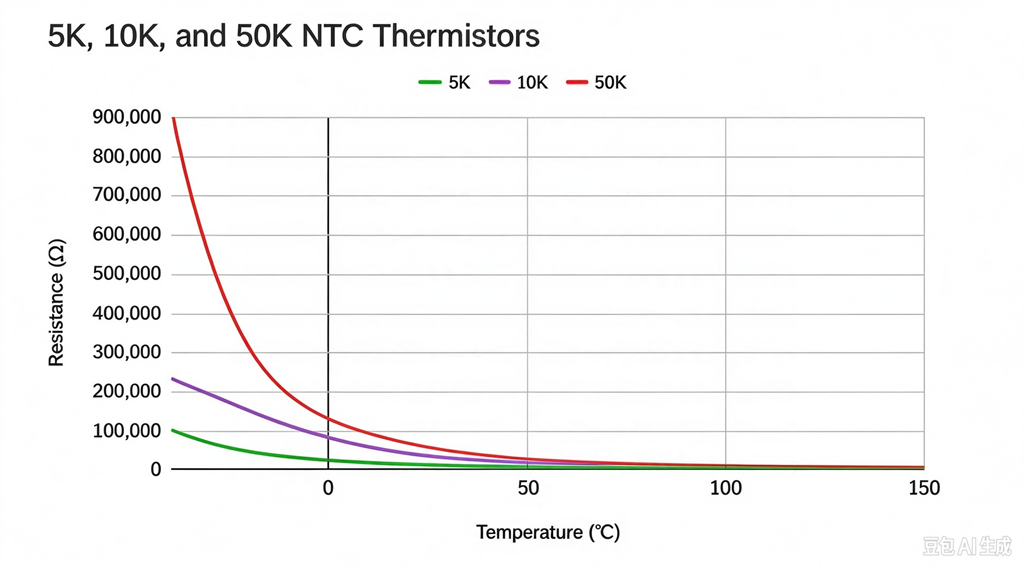
However, R25 does not describe the thermistor’s entire electrical behavior. Two thermistors with the same R25 may have different resistances at 0°C, 50°C, or 100°C if their B values or resistance-temperature curves differ.
This guide explains the meaning of R25, how it relates to other NTC thermistor specifications, and what engineers and purchasing professionals should check before choosing a component.
1. What Does R25 Mean?
The notation R25 combines two pieces of information:
- R: Electrical resistance.
- 25: The reference temperature of 25°C.
Therefore, R25 is the nominal resistance specified at 25°C under the manufacturer’s stated measurement conditions.
Common nominal resistance values include 1 kΩ, 2.2 kΩ, 5 kΩ, 10 kΩ, 47 kΩ, and 100 kΩ. These are examples of commonly encountered values, not a universal list of available specifications.
The appropriate resistance depends on the thermistor’s intended application, the measurement circuit, the required temperature range, and the characteristics of the selected product series.
For example, a design may use a 10 kΩ NTC thermistor connected to a fixed resistor in a voltage-divider circuit. The controller measures the resulting voltage and converts it into a temperature value using a suitable conversion method or resistance-temperature table.
If the thermistor is replaced with a different nominal resistance, the circuit response changes. The controller’s resistor values, voltage range, software conversion data, or calibration may need to be reviewed.
Important: R25 is a reference resistance, not a resistance that remains constant at all temperatures.
2. Why Is Resistance Specified at 25°C?
A common reference temperature allows manufacturers, engineers, and buyers to describe and compare thermistor specifications consistently.
Because an NTC thermistor’s resistance changes significantly with temperature, its resistance must always be associated with a specified temperature.
For example, a thermistor may have a resistance of 10 kΩ at 25°C and a substantially higher resistance at a lower temperature. At a higher temperature, its resistance will generally be lower.
Using a common reference point makes it easier to identify a component’s nominal resistance and communicate its basic specification.
Manufacturers such as Vishay and TDK list resistance at 25°C alongside other parameters, including resistance tolerance, B value, and operating temperature range. These parameters should be considered together when selecting a thermistor.
3. Does R25 Determine the Resistance at Other Temperatures?
No. R25 defines the nominal resistance at 25°C, but it does not fully describe the resistance-temperature relationship.
NTC thermistors have a negative temperature coefficient: their resistance generally decreases as temperature increases.
The relationship is nonlinear. Therefore, resistance does not decrease by the same amount for every one-degree temperature increase.
The B value is commonly used to approximate the relationship between resistance and temperature over a specified interval. However, the actual resistance-temperature characteristics of a particular thermistor should be obtained from its datasheet or RT table.
Consider two hypothetical NTC thermistors:
| Parameter | Thermistor A | Thermistor B |
| R25 | 10 kΩ | 10 kΩ |
| B25/85 | 3435 K | 3950 K |
| Resistance at 25°C | Nominally 10 kΩ | Nominally 10 kΩ |
| Resistance at other temperatures | Determined by its own curve | Determined by its own curve |
The values above are illustrative. They are not specifications for a particular manufacturer’s product.
Although both thermistors have the same nominal resistance at 25°C, their resistance-temperature characteristics differ. Consequently, they cannot automatically be substituted for each other in an existing circuit.
This is especially important when replacing an existing NTC thermistor or sourcing an alternative component for mass production.
4. What Is R25 Tolerance?
R25 tolerance describes the permitted deviation of the actual resistance at 25°C from its nominal value under the specified measurement conditions.
For example, suppose an NTC thermistor has these specifications:
- Nominal R25: 10 kΩ
- R25 tolerance: ±1%
The permitted resistance range at 25°C is:
Minimum resistance = 10,000 × 0.99 = 9,900 Ω
Maximum resistance = 10,000 × 1.01 = 10,100 Ω
Therefore, the specified range is 9.90–10.10 kΩ at 25°C.
For a 10 kΩ thermistor with ±5% R25 tolerance, the corresponding nominal limits would be 9.50–10.50 kΩ.
These examples demonstrate why resistance tolerance matters when selecting components for a measurement circuit.
However, a tighter R25 tolerance does not automatically guarantee better temperature accuracy throughout the entire operating range.
The final measurement accuracy also depends on B-value tolerance, resistance-temperature curve characteristics, the measurement circuit, calibration, thermal coupling, and other application conditions.
5. How Does R25 Tolerance Affect Temperature Measurement?
A controller generally does not measure temperature directly with an NTC thermistor. Instead, it measures an electrical signal, estimates resistance, and converts that resistance into a temperature.
If the actual resistance differs from the resistance assumed by the controller, the calculated temperature may differ from the actual temperature.
The relationship between resistance error and temperature error depends on the thermistor’s resistance-temperature curve.
For an idealized NTC thermistor described by the beta model, the approximate relationship is:
[
R(T)=R_{25}\exp\left[B\left(\frac{1}{T}-\frac{1}{T_{25}}\right)\right]
]
Here, temperatures are expressed in kelvins.
The equation shows that resistance depends on both R25 and B. A deviation in either parameter can influence the calculated temperature.
For this reason, engineers should distinguish between resistance tolerance and temperature measurement accuracy.
If an application requires a specific temperature accuracy, the component should be evaluated against the complete error budget rather than selected solely by its R25 tolerance.
Depending on the application, the design may require a tighter resistance tolerance, a more tightly controlled B value, individual calibration, or a custom resistance-temperature specification.
6. How to Choose the Right R25
The correct R25 depends on the electrical design and operating requirements.
6.1 Check the Existing Circuit
If the thermistor is used in an existing product, begin with the original circuit or component specification.
Confirm the nominal resistance, reference temperature, fixed resistor values, supply voltage, measurement range, and conversion method.
Do not change R25 without checking whether the circuit and firmware can accommodate the alternative.
6.2 Consider the Measurement Temperature Range
The intended temperature range influences the resistance values the circuit must measure.
A thermistor may have a suitable resistance at 25°C but produce resistance values outside the useful range of the measurement circuit at very low or high temperatures.
Review the expected resistance across the full operating range, not only at 25°C.
6.3 Evaluate Circuit Resolution and Power Dissipation
The chosen resistance affects circuit current and the voltage generated by a measurement circuit.
A higher resistance may reduce current under certain circuit conditions, but it can also interact with input leakage, noise, and sampling behavior. A lower resistance may increase current and self-heating if the circuit is not designed appropriately.
The best choice depends on the complete circuit rather than a universal preference for high or low resistance.
6.4 Check the Manufacturer’s Available Specifications
When selecting a standard component, compare the manufacturer’s available R25 values, B values, tolerances, operating temperature range, package structure, and lead configuration.
If no standard product meets the requirements, ask whether the manufacturer can offer a customized specification.
7. What Does a 10 kΩ NTC Thermistor Mean?
A 10 kΩ NTC thermistor generally means a thermistor with a nominal resistance of 10 kΩ at 25°C.
However, the description alone is insufficient to identify a fully interchangeable component.
A complete specification may also include:
- B25/50, B25/85, or another defined B-value interval.
- R25 tolerance.
- B-value tolerance.
- Operating temperature range.
- Encapsulation material and physical dimensions.
- Lead material, length, and insulation.
- Required resistance values at other temperatures.
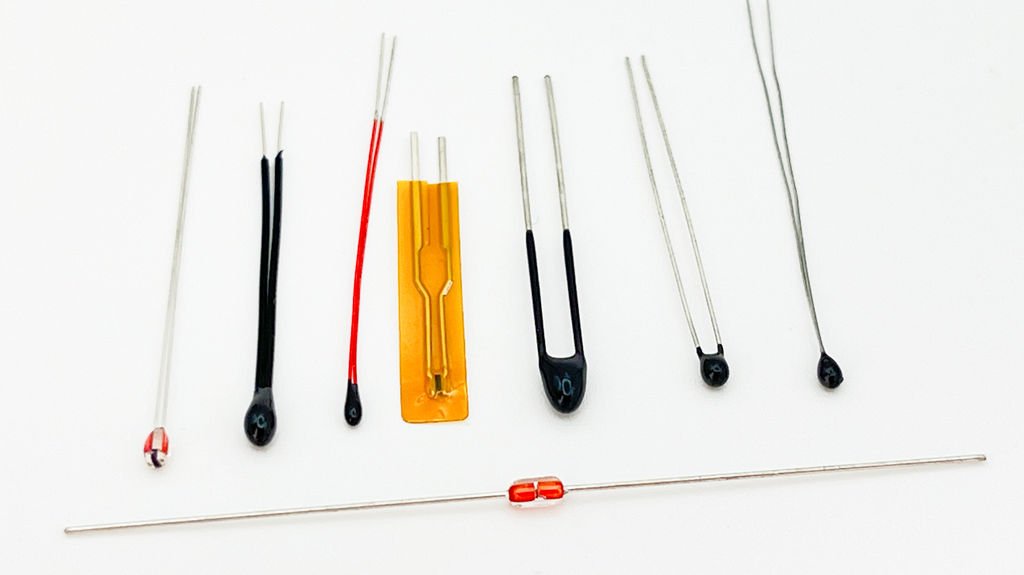
For example, a 10 kΩ epoxy-coated thermistor and a 10 kΩ glass-encapsulated thermistor may differ in response time, environmental suitability, dimensions, and permitted operating conditions.
Similarly, two 10 kΩ thermistors may have different B values.
When requesting a quotation, use the complete specification whenever possible rather than providing only the nominal resistance.
8. R25 and NTC Thermistor Replacement
R25 is one of the first parameters to check when replacing an existing thermistor, but it is not sufficient on its own.
A replacement evaluation should compare the original and alternative components in the following areas:
- Nominal resistance at 25°C.
- B value and specified temperature interval.
- Resistance-temperature data across the required range.
- R25 and B-value tolerances.
- Package dimensions and encapsulation.
- Lead configuration and electrical connections.
- Operating temperature and environmental requirements.
- Response time and stability requirements.
If the original part number is unavailable, obtain the datasheet, RT table, drawing, or a sample whenever possible.
Resistance measurements at several known temperatures may help characterize an unknown component. However, measurements should be made using controlled conditions and appropriate equipment. A few measurements cannot always establish full interchangeability or long-term reliability.
Before approving a replacement for mass production, verify it in the intended circuit and application environment.
9. What Should You Ask an NTC Thermistor Manufacturer?
When discussing R25 with a supplier, clarify the following:
- Is R25 specified at 25°C?
- What is the permitted resistance tolerance?
- What B value and temperature interval apply?
- Is a complete RT table available?
- What are the measurement conditions?
- Are custom R25 values or tighter tolerances available?
- Can the manufacturer provide samples and relevant inspection data?
- Can the manufacturer maintain the agreed specification in mass production?
A capable supplier should be able to explain how the electrical parameters relate to the application and identify any missing information needed to evaluate the component.
Conclusion
R25 is the nominal resistance of an NTC thermistor at 25°C. It is a fundamental specification used in component selection, circuit design, purchasing, and replacement evaluation.
Nevertheless, R25 alone does not define the thermistor’s performance at other temperatures. B value, resistance tolerance, RT characteristics, package construction, and application conditions must also be considered.
For engineers and OEM purchasing teams, the most reliable approach is to specify the complete electrical and mechanical requirements before selecting a component.
Need help selecting an NTC thermistor?
Temprix supplies NTC thermistors and temperature sensor solutions for OEM and industrial applications. Share your required R25, B value, operating temperature range, drawing, or existing part number with our team to discuss a suitable standard or customized solution.