
Introduction
The B value, also known as the beta value or B constant, is one of the key electrical parameters used to describe an NTC thermistor.
It helps characterize how the thermistor’s resistance changes with temperature. Together with the nominal resistance at 25°C (R25), the B value is commonly used to estimate resistance at other temperatures.
However, B value is often misunderstood. Some buyers compare two thermistors based only on their R25 values, while others compare B values without checking the temperature interval over which those values were specified.
Both approaches can lead to incorrect component selection.
For example, B25/50 and B25/85 describe B values calculated over different temperature intervals. Even when two datasheets display similar numerical values, the specifications should not be assumed to be identical without reviewing the definitions and resistance-temperature data.
This guide explains what the NTC thermistor B value means, how it is calculated, how B-value tolerance affects performance, and how engineers can use it when selecting or replacing an NTC thermistor.
1. What Is the B Value of an NTC Thermistor?
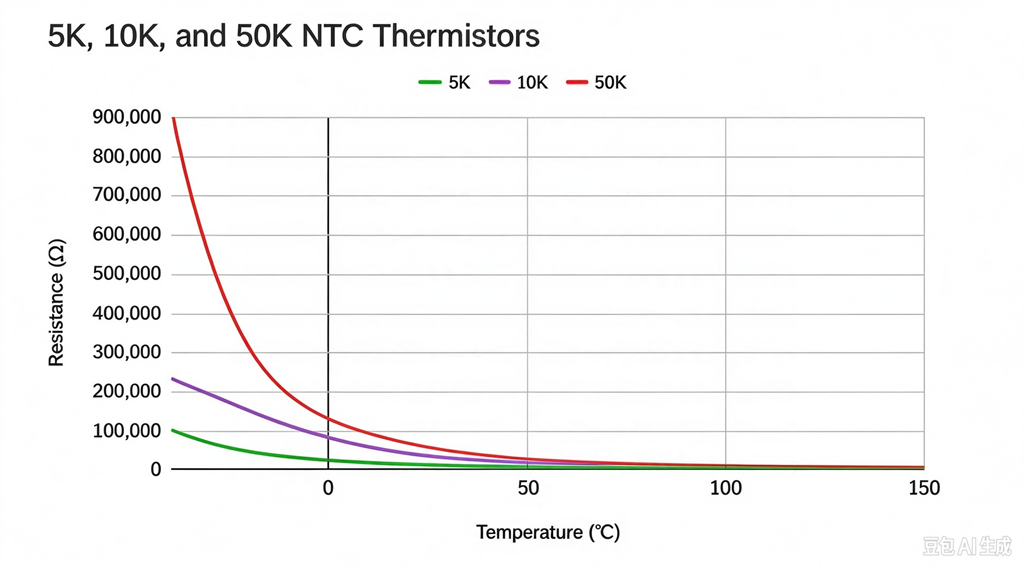
An NTC thermistor is a temperature-sensitive resistor whose resistance generally decreases as temperature increases.
The B value describes the steepness of the resistance-temperature relationship over a specified temperature interval when using the commonly applied beta model.
It is expressed in kelvins (K). Although temperature differences in degrees Celsius and kelvins have the same numerical magnitude, the equation uses absolute temperatures in kelvins.
A typical specification may be written as:
- B25/50
- B25/85
- B25/100
The subscripts identify the reference temperatures used to calculate the B value.
For example, B25/85 refers to the beta value calculated using the resistance at 25°C and the resistance at 85°C, according to the applicable definition.
The B value is not the thermistor’s resistance, nor is it the temperature coefficient expressed as a percentage per degree. It is a parameter used to approximate the nonlinear resistance-temperature relationship.
Manufacturers such as Vishay and TDK publish B values alongside R25, tolerances, and operating temperature information in their product specifications. These parameters should be evaluated together when choosing a component.
2. Why Is the B Value Important?
R25 describes the nominal resistance at a single reference temperature. It does not fully describe how resistance changes at other temperatures.
The B value provides additional information about the shape of the resistance-temperature relationship.
Consider two hypothetical thermistors, both rated at 10 kΩ at 25°C:
| Parameter | Thermistor A | Thermistor B |
| R25 | 10 kΩ | 10 kΩ |
| B25/85 | 3435 K | 3950 K |
| Resistance at 25°C | Nominally 10 kΩ | Nominally 10 kΩ |
| Resistance at other temperatures | Different characteristic | Different characteristic |
These numbers are illustrative, not specifications for real products.
Although the nominal resistance at 25°C is the same, the two thermistors will generally have different resistance values away from 25°C.
If the thermistor is used in a controller, the controller converts measured resistance into temperature. Using a conversion table for the wrong B value may therefore result in incorrect temperature calculations.
This is why B-value compatibility is particularly important when replacing an existing thermistor or selecting a second source for an established product.
3. The NTC Thermistor B-Value Formula
The commonly used beta equation is:
[
R(T)=R(T_0)\exp\left[B\left(\frac{1}{T}-\frac{1}{T_0}\right)\right]
]
Where:
- (R(T)) is the resistance at temperature (T).
- (R(T_0)) is the resistance at the reference temperature (T_0).
- (B) is the beta value for the specified interval.
- (T) and (T_0) are absolute temperatures in kelvins.
- (\exp) represents the exponential function.
When the reference temperature is 25°C, the equation becomes:
[
R(T)=R_{25}\exp\left[B\left(\frac{1}{T}-\frac{1}{298.15}\right)\right]
]
This form is useful for estimating resistance when R25 and a suitable B value are known.
However, the equation is an approximation. A single B value does not perfectly represent every thermistor across every temperature range.
For more accurate work, use the manufacturer’s resistance-temperature table or a more detailed model when the datasheet provides one.
4. How Is the B Value Calculated?
The B value can be calculated from resistance measurements at two specified temperatures.
Starting with the beta equation:
[
B=\frac{\ln[R(T_1)/R(T_2)]}{(1/T_1)-(1/T_2)}
]
Where:
- (R(T_1)) is the resistance at the lower reference temperature.
- (R(T_2)) is the resistance at the higher reference temperature.
- (T_1) and (T_2) are absolute temperatures in kelvins.
- (\ln) is the natural logarithm.
For a B25/85 calculation:
- (T_1=298.15\text{ K})
- (T_2=358.15\text{ K})
The resistance values must correspond to those temperatures and should be measured under the specified conditions.
An illustrative example
Suppose a hypothetical NTC thermistor has these measured resistances:
- R25 = 10,000 Ω
- R85 = 1,450 Ω
Substituting the values into the equation gives an approximate B25/85 value:
[
B_{25/85}=
\frac{\ln(10000/1450)}
{(1/298.15)-(1/358.15)}
]
The result is approximately 3,950 K.
This is an illustrative calculation. Actual production specifications should use the manufacturer’s defined test methods, tolerances, and resistance data.
When measuring resistance to calculate B, ensure that the thermistor has reached thermal equilibrium at each test temperature. Measurement current should also be controlled to minimize self-heating.
5. What Is the Difference Between B25/50 and B25/85?
The difference lies in the temperature interval used to define the B value.
- B25/50: Calculated using resistance at 25°C and 50°C.
- B25/85: Calculated using resistance at 25°C and 85°C.
- B25/100: Calculated using resistance at 25°C and 100°C.
The numerical values are not necessarily identical because the resistance-temperature curve is nonlinear.
The beta equation approximates this curve over a defined interval. As the interval changes, the calculated value may also change.
Therefore, engineers should not compare B25/50 directly with B25/85 as if both were necessarily the same specification.
When sourcing an alternative thermistor, check the exact B-value definition in both datasheets. If the intervals differ, obtain resistance data at common temperatures or compare the complete RT tables.
A replacement component should be evaluated using the resistance values relevant to the actual operating range rather than a single B-value number alone.
6. Does a Higher B Value Mean a Better Thermistor?
No. A higher B value does not automatically indicate better quality, greater accuracy, or longer service life.
It indicates a different resistance-temperature characteristic within the specified model and temperature interval.
The appropriate B value depends on the intended circuit, operating temperature range, and required resistance-temperature relationship.
A thermistor with a higher B value may be suitable for one design but unsuitable for another.
For example, a replacement component with the same R25 but a different B value may produce resistance values that differ significantly at temperatures away from 25°C. If the original controller uses a fixed conversion table, those differences can affect the reported temperature.
When selecting a thermistor, prioritize compatibility with the required resistance-temperature curve and overall measurement performance rather than choosing the highest available B value.
7. What Is B-Value Tolerance?
B-value tolerance describes the permitted deviation of the specified B value under the manufacturer’s stated conditions.
For example, a specification may state:
- Nominal B25/85: 3950 K
- B-value tolerance: ±1%
The corresponding nominal limits would be:
[
B_{\min}=3950(1-0.01)=3910.5\text{ K}
]
[
B_{\max}=3950(1+0.01)=3989.5\text{ K}
]
These are calculated limits for the illustrative specification.
B-value tolerance matters because a deviation in B can change the predicted resistance at temperatures away from the reference point.
However, B-value tolerance alone does not describe all sources of temperature measurement error.
R25 tolerance, resistance-temperature curve deviations, circuit tolerances, self-heating, thermal contact, and calibration can also influence the final result.
For demanding applications, engineers should evaluate the combined measurement error rather than treating R25 or B tolerance as the sole indicator of accuracy.
8. How Does B Value Affect Temperature Measurement Accuracy?
An NTC thermistor typically measures temperature indirectly through resistance.
A measurement circuit estimates the resistance, then uses an equation, lookup table, or other conversion method to calculate temperature.
If the actual thermistor’s resistance-temperature characteristic differs from the characteristic assumed by the controller, the calculated temperature may be inaccurate.
The potential error depends on the thermistor, the operating temperature, the conversion method, and the other sources of error in the system.
For example, a controller calibrated for one B value may not produce the same readings when connected to a thermistor with a different B value, even if both components have the same R25.
Possible ways to improve performance include:
- Selecting a thermistor with a suitable B value and tolerance.
- Using the correct manufacturer’s RT table.
- Evaluating the resistance-temperature curve over the full operating range.
- Applying calibration when required by the accuracy specification.
- Controlling measurement current to reduce self-heating.
- Verifying the completed sensor assembly in the intended environment.
For precision applications, do not assume that a beta equation will always provide sufficient accuracy across a wide temperature range. Use the most appropriate characterization method available for the selected component.
9. B Value and Resistance-Temperature Tables
A resistance-temperature table lists the thermistor’s resistance at specified temperatures.
For example, an RT table may include values at -40°C, -20°C, 0°C, 25°C, 50°C, 85°C, and 100°C.
The actual temperature points and resistance values depend on the product specification.
An RT table is useful because it allows engineers to compare the actual resistance-temperature behavior of two thermistors.
This is especially important when:
- Replacing a discontinued thermistor.
- Qualifying an alternative supplier.
- Developing a new temperature-sensing circuit.
- Checking measurement accuracy at critical temperatures.
- Evaluating a custom resistance-temperature requirement.
When comparing tables, verify that both products use the same nominal resistance, temperature reference, and relevant test conditions. Also check whether the listed resistance values are nominal, measured, or tolerance limits.
If a design depends on tight resistance limits at particular temperatures, the relevant RT table and tolerance specification should form part of the component approval process.
10. How to Select the Right B Value for Your Application
Use the following process when selecting an NTC thermistor.
Step 1: Identify the operating temperature range
Determine the minimum, maximum, and important control temperatures.
Step 2: Confirm R25
Check the required nominal resistance at 25°C and verify that it suits the measurement circuit.
Step 3: Obtain the original RT curve
If replacing an existing component, request its datasheet or resistance-temperature table.
Step 4: Compare the specified B-value intervals
Confirm whether the specification is B25/50, B25/85, B25/100, or another defined interval.
Step 5: Evaluate tolerances
Review both R25 and B-value tolerances, along with any specified resistance limits at critical temperatures.
Step 6: Check the physical construction
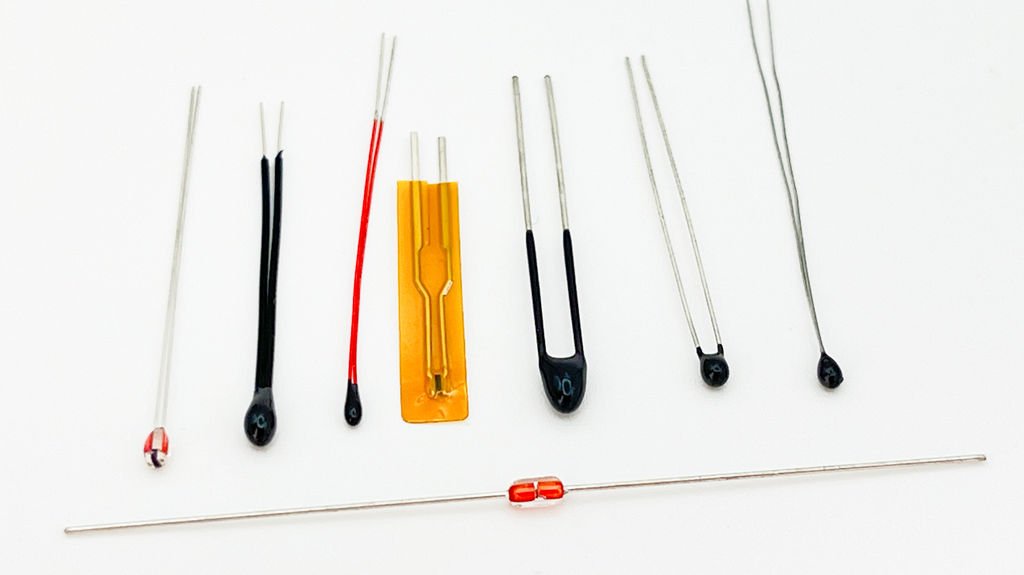
Verify the package, encapsulation, lead wires, probe design, and environmental requirements.
Step 7: Validate the complete design
Test the selected thermistor in the intended circuit and installation environment. If the application requires tight accuracy, include calibration and uncertainty evaluation where appropriate.
This process helps avoid selecting a thermistor based on a single parameter that does not fully represent the application’s requirements.
11. What Information Should You Provide to a Manufacturer?
When requesting an NTC thermistor quotation, provide as much of the following information as possible:
- Nominal R25.
- Required B value and temperature interval.
- R25 and B-value tolerances.
- Operating temperature range.
- Required resistance limits at critical temperatures.
- Package type and physical dimensions.
- Lead-wire specifications.
- Application environment.
- Annual demand and sample quantity.
- Existing part number, datasheet, drawing, or RT table.
If the application requires a custom resistance-temperature curve, explain the required resistance values at key temperatures rather than specifying only a nominal B value.
A manufacturer can then assess whether a standard product is suitable or whether a customized specification should be considered.
Conclusion
The B value is a key parameter describing an NTC thermistor’s resistance-temperature relationship over a specified interval.
It works together with R25 to estimate resistance at other temperatures, but it does not independently define every aspect of thermistor performance.
When choosing or replacing an NTC thermistor, verify the B-value interval, tolerance, resistance-temperature table, operating conditions, and physical construction. For demanding applications, evaluate the complete measurement system rather than relying on a single specification.
Looking for an NTC thermistor with a specific B value?
Temprix supplies NTC thermistors and temperature sensor solutions for OEM and industrial applications. Share your R25, B value, operating temperature range, required resistance limits, or existing component datasheet with our team.
We can review your requirements and discuss suitable standard or customized thermistor solutions.