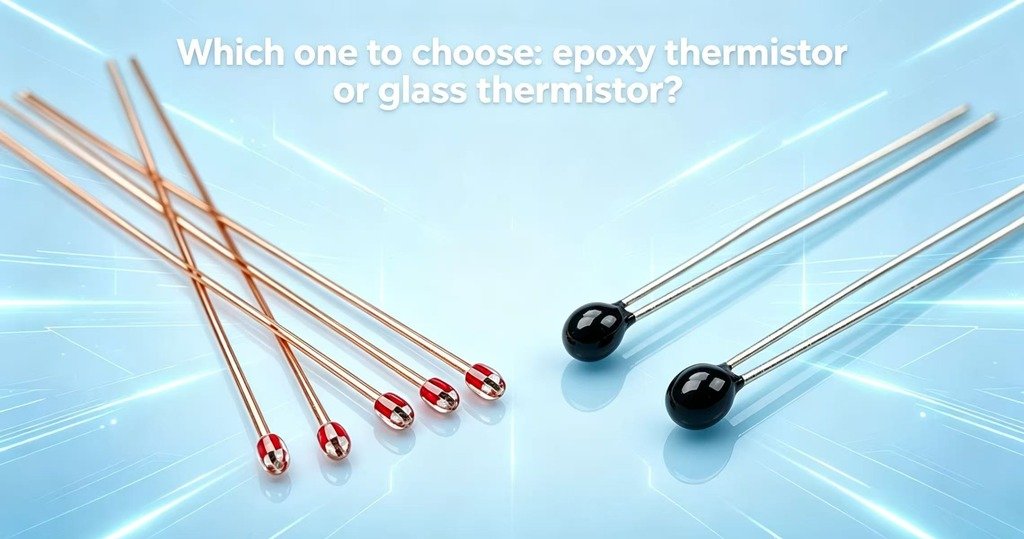
In temperature measurement and control systems, the encapsulation method of an NTC thermistor plays a decisive role in its performance. The two mainstream encapsulation options available today are glass-encapsulated and epoxy-coated thermistors. This article provides a systematic comparison from the perspectives of thermal response, environmental durability, mechanical reliability, and cost-effectiveness, aiming to offer engineers a clear technical reference for the selection process.
1.Introduction
Encapsulation is not merely a physical protective layer for a thermistor; it is a key factor that influences core performance. The thermal conductivity, specific heat capacity, dielectric isolation capability, and temperature tolerance of the encapsulation material collectively determine the sensor’s applicable boundaries and use cases. A proper understanding of the technical differences between glass encapsulation and epoxy coating is a prerequisite for making an optimal selection.
2.Technical Characteristics of Glass-Encapsulated Thermistors
2.1 Construction and Process Features
Glass-encapsulated thermistors are manufactured by hermetically sealing an NTC chip inside a glass enclosure through a high-temperature fusion process, forming a dense inorganic protective layer. This construction achieves complete physical isolation between the sensing element and the external environment.
2.2 Performance Advantages
High-Temperature Tolerance: The softening point of glass materials typically exceeds 500°C, allowing glass-encapsulated thermistors to operate stably over a wide temperature range of -50°C to +300°C. This characteristic makes them irreplaceable in high-temperature applications such as industrial process control and automotive engine compartments.
Long-Term Stability: Because glass completely blocks oxygen and moisture, the annual resistance drift of glass-encapsulated thermistors can be controlled below 0.01%. This means that over years of use, their measurement accuracy remains virtually unchanged.
Environmental Resilience: The inorganic glass structure is chemically inert to moisture, oxygen, and most solvents, completely preventing insulation resistance degradation caused by moisture ingress. This property is particularly important in salt-spray environments or chemically corrosive conditions.
2.3 Performance Limitations
Slower Thermal Response: The glass enclosure has a certain thickness and specific heat capacity, requiring more time for heat to penetrate this barrier. In applications requiring rapid capture of transient temperature changes, glass-encapsulated thermistors may exhibit noticeable lag.
Mechanical Brittleness: While glass encapsulation offers high compressive strength, it is sensitive to tensile stress and impact loads. In applications with high vibration or drop risk, additional mechanical protection measures may be necessary.
2.4 Suitable Applications
Automotive engine compartment temperature monitoring (exhaust systems, coolant)
Industrial process control (ovens, hot runners, high-temperature reactors)
Medical sterilization equipment (autoclaves)
Refrigeration system discharge temperature protection
3.Technical Characteristics of Epoxy-Coated Thermistors
3.1 Construction and Process Features
Epoxy-coated thermistors are manufactured by applying a layer of polymer epoxy resin onto the NTC chip surface through dipping or spraying processes. This mature, high-efficiency process is well-suited for high-volume standardized production.
3.2 Performance Advantages
Fast Thermal Response: Epoxy coatings are typically tens to hundreds of microns thick, and polymer materials have relatively low thermal resistance. This allows the thermal time constant of epoxy-coated thermistors to be reduced to 3 to 10 seconds, offering a significant advantage in applications requiring rapid temperature change detection.
Good Mechanical Adaptability: Epoxy resin has favorable elastic modulus, effectively absorbing board flexural stress and external vibration impacts, reducing the risk of coating cracking. This makes epoxy-coated thermistors suitable for equipment subject to mechanical deformation or vibration.
Cost-Effectiveness: The epoxy coating process does not require high-temperature sealing, resulting in lower manufacturing costs, making it suitable for high-volume, cost-sensitive applications.
3.3 Performance Limitations
Limited Temperature Range: Standard epoxy resins typically have a long-term operating temperature not exceeding 125°C. Above 150°C, epoxy coatings may soften, discolor, and eventually carbonize, losing their protective function and limiting their use in high-temperature scenarios.
Limited Moisture Resistance: Epoxy coatings offer some moisture barrier capability but cannot achieve complete sealing. Under prolonged high-humidity or thermal cycling conditions, water molecules may slowly permeate through gaps in the polymer chains, leading to insulation degradation. This effect is particularly noticeable in high-resistance (e.g., above 100 kΩ) circuits.
3.4 Suitable Applications
Home appliances (air conditioners, refrigerators, washing machines)
HVAC systems (duct, return air, water temperature sensing)
Consumer electronics (battery packs, power device temperature monitoring)
General industrial control cabinets
4.Technical Parameter Comparison
Parameter Glass-Encapsulated Epoxy-Coated
Operating Temperature Range -50°C to +300°C -40°C to +125°C
Thermal Time Constant (Typical) 10 to 30 seconds 3 to 10 seconds
Long-Term Drift (1000 hrs @125°C) <0.01% 0.5% to 2%
Moisture Resistance Hermetically sealed Limited protection
Chemical Resistance Excellent Fair
Mechanical Shock Resistance Moderate (prone to cracking) Good
Unit Cost Higher Lower
5.Selection Recommendations
5.1 Based on Operating Temperature
If the system’s maximum operating temperature exceeds 125°C, or if frequent thermal shock (e.g., rapid transition from low to high temperature) exists, glass encapsulation should be prioritized. Epoxy coatings risk thermal degradation and micro-cracking under these conditions.
5.2 Based on Response Speed
For applications requiring rapid capture of transient temperature changes (e.g., respiratory airflow monitoring, motor winding protection), epoxy coatings offer advantages due to their lower thermal time constant.
5.3 Based on Environmental Conditions
In long-term high-humidity, salt-spray, or chemically corrosive environments, the hermetic seal of glass encapsulation is necessary to ensure long-term measurement accuracy.
5.4 Based on Cost Constraints
For applications where maintenance is difficult and failure costs are high (e.g., industrial automation equipment), glass encapsulation, despite higher initial cost, reduces long-term maintenance expenses. For high-volume, short-lifecycle consumer products, epoxy-coated solutions are more economical.
6.Conclusion
Glass-encapsulated and epoxy-coated thermistors serve different technical needs. Glass encapsulation, with its superior environmental isolation and high-temperature stability, is suitable for long-term monitoring tasks in harsh conditions. Epoxy coating, with its fast response and good mechanical adaptability, satisfies the requirements of many general-purpose applications. The selection should be based on the specific operating temperature range, response speed requirements, environmental conditions, and cost constraints, achieving a reasonable engineering trade-off.